
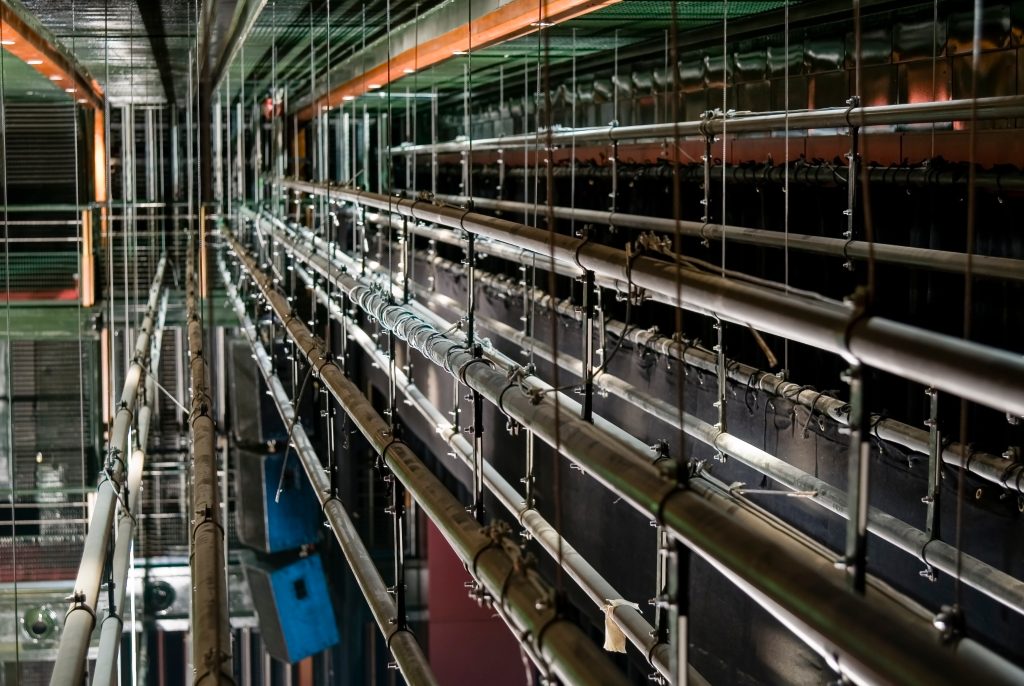
Theatrical stage counterweight rigging systems are essential to modern stagecraft, allowing scenery, lighting, and curtains to move safely and efficiently. However, a stage rigging system is fundamentally a machine, and like any machine, it requires regular inspection and maintenance to remain safe. So, how often should you inspect your theatre’s counterweight rigging?
⚠️ When Was Your Last Inspection?
You’re currently compliant
You’re overdue for inspection
Significant compliance risk
⏰ Currently scheduling weekdays 90-120 days in advance, with some weekend availability 15-45 days in advance.
We Inspect Nationwide. Call (800) 792-0711
The Industry Standard: Annual Inspections
According to ANSI E1.47-2020, Recommended Guidelines for Entertainment Rigging System Inspections, as well as guidelines from major manufacturers including H&H Specialties, J.R. Clancy, ETC, and Thern, both manually operated and motorized rigging systems require inspection at least annually. ANSI E1.4-1-2022, Entertainment Technology – Manual Counterweight Rigging Systems, reinforces this requirement in section 5.2.2.1, which states: “Installed systems shall be inspected annually or more frequently, as determined by a qualified person, per the manufacturer’s recommendations and local code requirements.”
The International Building Code (IBC) Section 20.9.1 requires: “The rigging system shall be inspected annually.” Section 20.9.1.1 adds: “The annual rigging inspection shall be performed by a qualified person.” In jurisdictions that have adopted the IBC, annual rigging inspections are not merely recommended practice but legally enforceable building code requirements.
🗓️ Summer 2026 Scheduling Alert
Most school districts schedule rigging inspections during summer break (June-August). Our schedule typically fills by late April. Facilities that wait until May often cannot secure inspection dates before school resumes.
Current Status: 15 Slots Remaining for Summer 2026
Understanding Inspection Levels
ANSI E1.47-2020 establishes two inspection levels based on access requirements and scope. Understanding the distinction is critical for budgeting, scheduling, and compliance.
Level 1 Inspections
Level 1 inspections are performed annually from safely accessible positions such as rigging galleries, catwalks, facility ladders, gridirons, or the stage floor. These inspections do not require access equipment such as aerial lifts or scaffolding.
Level 1 inspections focus on readily accessible components including:
- Battens and pipe weight
- Counterweight arbors and counterweights
- Rope locks and purchase lines
- Loft blocks, head blocks, and tension blocks (where accessible)
- Loading bridge railings and edge protection
- Signage and load markings
- Logbooks, training records, and operational documentation
- Flame retardancy documentation for stage curtains
Level 1 inspections provide essential verification that accessible system components remain in safe operating condition and that required documentation is current and available.
Level 2 Inspections
Level 2 inspections require access equipment (aerial work platforms, scaffolding, or ladders) to examine all rigging components including those inaccessible during Level 1 inspections. The inspector evaluates all components of all sets, including lifting media terminations, grid-level equipment, and out-of-reach hardware.
Level 2 inspections are required:
- Every 5 years for manually operated counterweight systems
- Annually for motorized or automated systems
- Immediately after equipment or components have been newly installed, altered, or repaired
- When the last inspection date is unknown or cannot be documented
- When system modifications have occurred, regardless of time since last inspection
Level 2 inspections evaluate:
- Grid-level equipment and structural attachments
- All rope and wire rope terminations
- Out-of-reach sheaves, blocks, and hardware
- Structural support points and beam clamps
- System compliance with original design intent
- System compliance with current ANSI standards
- Motorized system components (motors, controllers, encoders, limit switches, emergency stops)
For a Level 2 Inspection, our clients provide the lift when one is required.
Why Motorized Systems Require Annual Level 2 Inspections
Motorized and automated rigging systems require annual Level 2 inspections (versus 5-year intervals for manual systems) due to additional complexity and failure modes. Motorized systems include motors, variable frequency drives, encoders, limit switches, emergency stop systems, and control programming that must be thoroughly evaluated annually. Components such as motor brakes, overload protection devices, and position feedback systems introduce failure modes not present in manual systems. The heightened inspection frequency reflects both the additional components requiring evaluation and the higher consequences of control system failures in automated environments.
Many manufacturers, including J.R. Clancy and ETC, require documented annual inspections by qualified personnel to maintain warranty coverage on motorized systems. Failure to maintain inspection documentation may void manufacturer warranties and create insurance coverage issues.
Our Inspection Services
StageRight Services provides comprehensive Level 2 inspections that exceed minimum requirements. Our approach ensures thorough evaluation of all system components, detailed documentation, and actionable recommendations for any deficiencies identified. While some inspection companies offer Level 1 inspections only, we focus on Level 2 inspections because they provide the most comprehensive assessment of system safety and compliance.
Who Is Qualified to Inspect Rigging Systems
Stage rigging inspections must be completed by a qualified person as defined by ANSI E1.47-2020. The inspector must have a minimum of 5 years or 10,000 hours of experience including a combination of entertainment rigging systems design, engineering, inspection, installation, maintenance, service, repair, modification, and functional testing.
Critically, ANSI E1.47 explicitly states: “Typically, experience only in system operation will not provide suitable experience to inspect entertainment rigging systems.” This exclusion distinguishes between operational competency and the comprehensive experience required for inspection qualification.
ETCP Certification and Inspector Qualifications
ETCP (Entertainment Technician Certification Program) Theatre Rigging certification demonstrates operational competency in the safe use of counterweighted systems, mechanical systems, and hydraulic systems typically installed in theatrical facilities. However, ETCP Theatre Rigging is an operator’s certification, not an inspector’s certification.
While ETCP certification demonstrates knowledge of safe rigging operation, it does not automatically qualify an individual as a rigging inspector under ANSI E1.47. The certification focuses on operational skills rather than the design, engineering, installation, and comprehensive inspection experience the standard requires.
A qualified inspector may hold ETCP certification, but must also possess substantial documented experience across design, engineering, installation, maintenance, and inspection disciplines. The breadth of experience required ensures inspectors can evaluate system compliance with design intent, identify non-standard installations, recognize modifications that compromise safety, and assess structural adequacy of support systems.
Our Inspector Qualifications
Our inspectors hold ETCP Theatre Rigging Certification and bring the comprehensive experience ANSI E1.47 requires. We are based in Missouri, where we are also State of Missouri Certified Safety Consultants. Our owner holds a Master’s degree in Occupational Safety Management, ETCP Theatre Rigging certification, and extensive experience in theater consulting, design, installation, and inspection. Our inspection team includes IATSE union journeymen with decades of combined experience across entertainment rigging disciplines.
We strongly encourage venues to verify that any rigging inspector they engage holds ETCP certification and can document the required breadth of experience across design, engineering, installation, and inspection disciplines.
Why Inspection Frequency Matters
According to OSHA incident reports and ESTA safety bulletins, rigging failures result from preventable conditions including:
- Worn or damaged wire rope and terminations
- Overloaded battens exceeding design capacity
- Improperly installed or missing safety components
- Inadequate maintenance of counterweight arbor guide systems
- Modified systems that no longer comply with design intent
- Deteriorated purchase line rope requiring replacement
- Missing or illegible load capacity signage
Without regular inspections by qualified personnel, these conditions go undetected until failure occurs. The consequences of rigging system failure extend far beyond the immediate safety incident.
Code Compliance
The International Building Code (IBC) Section 20.9.1 requires annual rigging inspections in jurisdictions that have adopted the IBC. This makes annual inspections a legally enforceable building code requirement, not merely industry best practice. Facility operators who fail to maintain compliant inspection schedules may face:
- Stop-work orders from building officials
- Occupancy permit revocation
- Fines and penalties for code violations
- Mandatory system shutdown until compliance is achieved
Liability Exposure
Failure to follow ANSI consensus standards can establish negligence per se in civil litigation. When industry standards are clearly defined, widely adopted, and referenced in building codes, deviation from those standards creates significant legal vulnerability. Courts recognize ANSI standards as representing the consensus professional judgment of the entertainment industry regarding safe practices.
Facility operators who fail to maintain required inspections face heightened liability in the event of rigging-related injuries. Defense arguments based on “we didn’t know” or “the system seemed fine” carry no weight when industry standards clearly require annual inspection by qualified personnel.
Insurance Consequences
Many liability insurance policies require documented compliance with industry standards and applicable building codes. Failure to maintain inspection records and evidence of compliance may:
- Void coverage for rigging-related incidents
- Result in coverage denial for claims arising from uninspected systems
- Increase premiums upon discovery of non-compliance
- Create gaps in coverage that expose the facility to uninsured losses
OSHA Compliance
OSHA regulation 29 CFR 1926.1501(a)(6) requires: “A thorough, annual inspection of the hoisting machinery shall be made by a competent person, or by a government or private agency recognized by the U.S. Department of Labor. The employer shall maintain a record of the dates and results of inspections for each hoisting machine and piece of equipment.”
While this regulation applies directly to construction hoisting equipment, OSHA applies similar competent person and inspection requirements to entertainment rigging through the General Duty Clause and industry recognition of ANSI standards. Failure to maintain inspection documentation creates OSHA citation exposure and demonstrates failure to provide a workplace free from recognized hazards.
Financial Consequences of Deferred Maintenance
Minor issues identified during annual inspections remain minor and inexpensive to remedy. Worn purchase line rope costs hundreds of dollars to replace during scheduled maintenance. The same worn rope that fails catastrophically during a production can result in:
- Emergency repair costs at premium rates
- Production cancellations and lost revenue
- Damage to scenery, lighting, and other equipment
- Injury-related costs and workers’ compensation claims
- Litigation expenses and settlement costs
- Reputational damage to the venue
“A counterweight rigging system is a machine, and like any other machine, it requires regular inspection and maintenance.” – Reid Neslage
😰 Worried About Compliance Gaps?
Our inspectors identify and document issues before your Authority Having Jurisdiction does. Get ahead of compliance problems with clear, actionable reports your board can understand.
Investment in Safety and Compliance
Transparent pricing helps you budget appropriately and understand the value of professional inspection.
💰 Typical Investment Range
Rigging inspection costs vary based on system complexity, age, number of linesets, access requirements, and facility location. Travel rate is based from Kansas City, Missouri.
$1,200 – $3,500
For most educational facilities (Level 2 comprehensive inspection)
$5,000 – $15,000
For most professional facilities (Level 2 comprehensive inspection)
✓ What’s Included in Every Inspection
⚖️ Cost Comparison: Prevention vs. Emergency
| Annual Inspection | $1,200 – $3,500 |
| Emergency repair after failure | $15,000 – $50,000+ |
| Production cancellation (lost revenue) | $10,000 – $100,000+ |
| Liability settlement | $500,000 – $5,000,000+ |
The question isn’t “can we afford inspection?” It’s “can we afford not to inspect?”
Consulting Only
Oftentimes we are asked if we will repair. As an impartial consultant we do not provide repair services.
Because we do not perform repairs or installations, we will are often not the cheapest because we can't offer low rates and make up for it with repair services. Sometimes our clients comment that the other guys' report is incomplete, typically because the rigging system is so bad that it's cheaper to replace it than repair it so the inspector doesn't say much they just fail everything. We recognize reports like that help nobody. We document the current conditions, and when it's not in compliance, we help you develop a plan to get in compliance. Our reports are thorough enough you can generally get non-binding repair quotes from most contractors.