
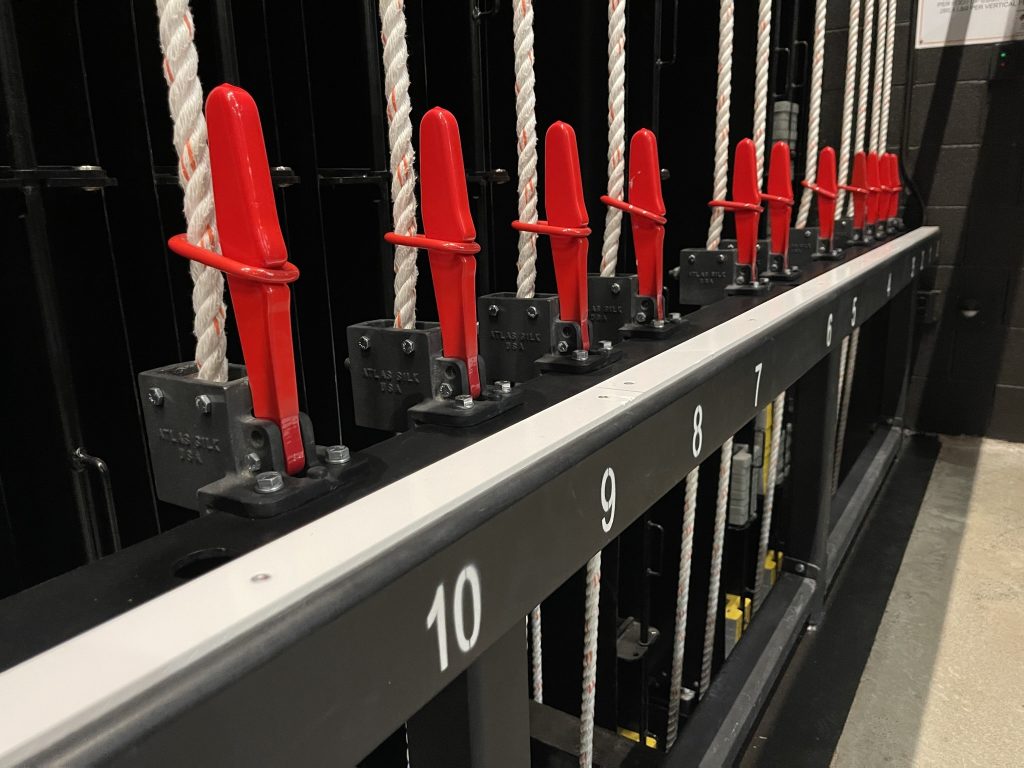
The locking rail is the long steel rail, usually along one side wall of the stage, that holds the rope lock for every counterweight lineset in the system. It is where operators stand to run the sets, and it is the one place in a theatre where every flown load is controlled by hand. A good locking rail layout keeps the sets in a clear, numbered order, gives the operator a safe and uncluttered place to stand, lets the operator see or hear what is happening on stage, and keeps people who are not operators away. An inspector looks at all of those things, not only at the hardware bolted to the rail.
In a counterweight system, each batten is balanced by an arbor loaded with steel weights. The arbor travels up and down in a track on the side wall. A purchase line, a loop of rope tied to the top and bottom of the arbor, passes through a rope lock mounted on the locking rail. The operator pulls the purchase line to move the set and closes the rope lock to hold it in place.
The rope locks sit side by side along the rail, one per lineset, in the same order as the battens over the stage. Set 1 is usually the batten nearest the proscenium, and the numbers climb toward the back wall. Above or below the locks, the rail usually carries an index strip or card holders where each set is labeled.
The rope lock is designed to hold a balanced set, not to hold a heavily out-of-balance load against the operator. That one fact explains why so much of the locking rail’s layout is about the operator’s attention and control.
Locking rail position depends on the type of system.
Single-purchase systems. The arbor travels the same distance as the batten. That means the arbor track runs from near the grid nearly to the stage floor, and the locking rail is usually at stage level, along the side wall.
Double-purchase systems. The arbor travels half the distance the batten does. That allows the arbor track to stay in the upper part of the wall, and the locking rail is often placed on a fly gallery above the stage floor, which frees the wing space below.
Either arrangement can be correct. What matters to the inspector is whether the rail, the access to it, and the space around it suit the system as installed.
Above the rail, in most systems, is a loading gallery where counterweight is added to or removed from the arbors. The loading gallery and its fall protection are a separate topic, but the inspector will note how loading is coordinated with the rail, because a set that is loaded or unloaded out of sequence is a set the rail operator can’t control.
The operator stands facing the rail with the purchase line in front of them, close enough to grip the line with both hands and work the rope lock without reaching. That position should allow three things.
A clear floor. The area directly behind the operator should be free of road cases, scenery, ladders, and cable. Operators step back while hauling a line. A trip hazard here is a direct threat to control of the set. OSHA’s walking-working surface requirements, 29 CFR 1910.22, apply to this floor as they do to any work surface: it should be kept clean, orderly, and free of hazards.
Enough light, and the right kind. The operator needs to read the labels and trim marks on the purchase lines. Most rails have dedicated work light, often blue or otherwise shielded so it doesn’t spill onto the stage during a performance. An inspector checks whether the rail can actually be read during a show.
A way to know what is happening on stage. From the rail, the operator often can’t see the whole batten or the people under it. A good setup gives a sightline to at least part of the stage, plus a means of communication, usually a headset or cue lights, with the stage manager. An operator who can’t see the batten and can’t hear the call is guessing, and a moving batten shouldn’t depend on a guess.
Every rope lock should be labeled with its set number, and the label should match the batten it controls. A current lineset schedule, posted at the rail, should show what each set is used for and what is hanging on it.
Inspectors check whether the labels exist, whether they can be read in performance lighting, and whether they match reality. A label that says “Border 2” on a set that now carries an electric is worse than no label, because it tells the operator the wrong thing. Load capacity signage for the system should also be posted where operators can see it.
Trim marks on the purchase lines are part of this too. Tape or other marks show the operator where a set’s in and out trims are. They should be legible, and old marks from past productions should be removed so they aren’t confused with current ones.
During an inspection, the rail gets attention on several levels. Common checks include:
Many of these items aren’t hardware, and an inspection that only looks at hardware will miss them. A locking rail with perfect rope locks and no labels, no light, and open access is not a safe rail.
ANSI E1.4-1 , Entertainment Technology: Manual Counterweight Rigging Systems, is the standard for these systems. Section 9.4 requires that all users be trained by a qualified person in the operation and use of the system. In practice, that means the people standing at the rail during a rehearsal or performance should have documented training, and the facility should be able to show who trained them and when.
The same standard covers the design and arrangement of locking rails and rope locks. ANSI E1.47, Entertainment Technology: Recommended Guidelines for Entertainment Rigging System Inspections, sets out how the system, including its operating positions, is inspected and documented.
For school owners, the practical rule is simple. The locking rail is a controlled work area, not backstage circulation. When nobody trained is there, it should be secured.
A related condition is worth a sentence here. If a set is out of balance, perhaps because a load was removed from the batten without removing weight from the arbor, the rope lock may not hold it, and the operator may not be able to control it by hand. An operator who senses a set pulling hard in either direction should stop, hold, and get help rather than release the lock to find out why.
Several locking-rail conditions can be corrected without a contractor:
These don’t replace an inspection, but they make the inspection more useful, because the findings will focus on the conditions that need a qualified person.
StageRight Inspections focuses on Level 2 inspections, and the locking rail is where we start, because it is where the system is operated. Our inspectors are ETCP Certified Theater Riggers. We don’t sell, install, or repair rigging equipment, so each locking-rail finding is written as a corrective action that any qualified contractor, or your own staff where appropriate, can complete.
To schedule stage rigging inspections for your venue, call (800) 792-0711 or email hello@stagerightinspections.com.